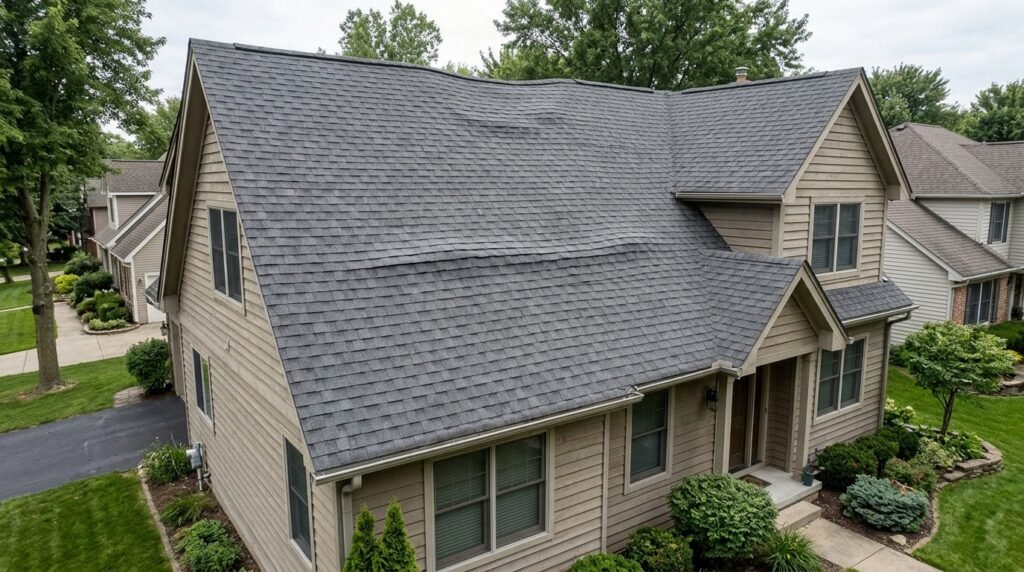
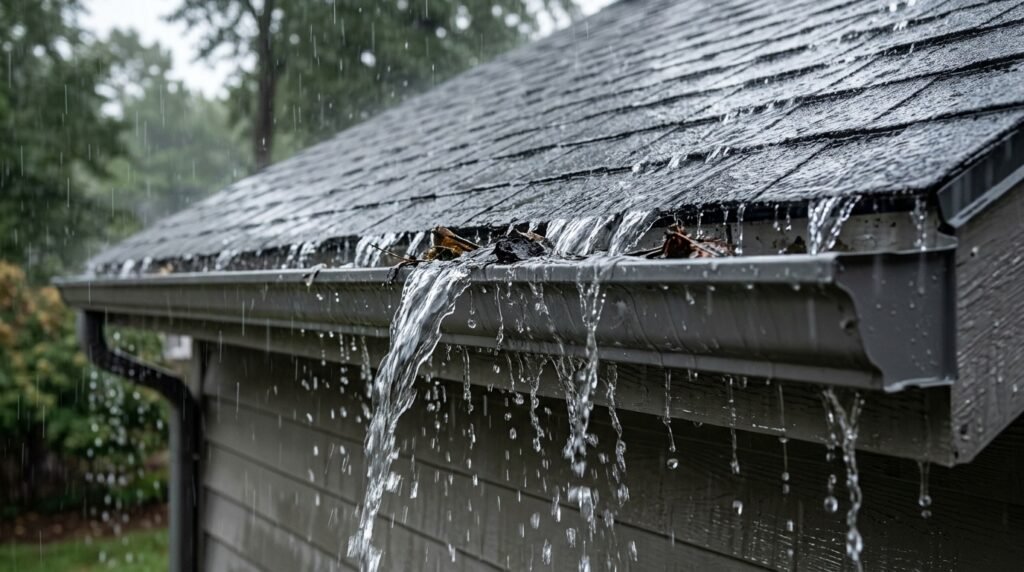
Water pools on a roof after rain because it can’t get away: the drain is blocked, the roof doesn’t slope enough toward the outlets, there’s a low spot or dip in the surface, or something is in the way. It’s most common on flat and low-slope roofs, but pitched roofs can hold water too, in valleys, behind chimneys and anywhere the roof has sagged. A little dampness that dries within a day or so is normal. Water that’s still sitting there two days later is a problem, because standing water finds every crack and slowly wears out the roof.
Below, we’ll explain what’s behind it, how to tell which cause you have, what you can safely do yourself, and how roofers fix it properly. If water pooling has already turned into a stain or a drip inside, our guide on why a ceiling leaks after heavy rain will help you with the first steps.
Want someone to look at your roof drainage? Contact AurexCity to book an inspection, meet the team on our About Us page, or browse more roofing guides. If you’d like to know what a proper inspection involves, read how professionals find hidden roof leaks.
Table of Contents
- What pooling water is, and what is normal
- Why pooling water is a problem
- Common causes on flat roofs
- Causes on pitched roofs
- How to work out why yours is pooling
- How to check safely
- Quick fixes you can do yourself
- Proper fixes for each cause
- How roofers correct slope problems
- Waterproofing and pooling
- When pooling points to something serious
- How to prevent it
- What affects the cost
- When to call a professional
- FAQ
- Final thoughts
What pooling water is, and what is normal
Pooling water, sometimes called ponding, is water that stays on the roof surface after the rain has stopped.
Some moisture is normal. After a shower, you’ll see wet patches and thin films of water, and on a hot day they’ll be gone within hours. That isn’t a problem.
The warning sign is water that doesn’t clear. A common rule of thumb in the roofing industry is that water still sitting on the roof around 48 hours after rain, in dry and warm conditions, counts as ponding and needs attention. It isn’t an exact line, and shaded or cold roofs dry more slowly, but if the same patch holds water day after day, or leaves a stain, algae or a dirty ring after it dries, take it seriously.
One more clue: a ring or tide-mark on the surface where a puddle used to be shows that water sits there repeatedly, even if it’s dry when you look.
Why pooling water is a problem
Standing water doesn’t look dramatic, but it quietly causes damage.
- Leaks. Water that sits on a roof has time to find every hairline crack, worn joint and tired patch of waterproofing. Water that runs off quickly rarely gets the chance.
- Faster wear. Constant wetness, combined with heat and sun, breaks down waterproofing layers, coatings, sealants and membranes much faster.
- Extra weight. Water is heavy. A layer just one centimetre deep over a square metre weighs about 10 kilograms. Over a large pool, that adds up, and it can make a slight dip deeper over time.
- Algae, moss and dirt. Standing water grows slimy algae and collects dust, which can make the surface slippery and block drains.
- Mosquitoes. Standing water is a breeding spot for mosquitoes, which matters for your family’s health, especially in the rainy season.
- Cracks and damage from heat and cold. Water in cracks expands and contracts with temperature, making them worse.
- Hidden damage. Over time, damp can reach the concrete or wood below, causing stains, rot, mould and rusted reinforcement.
If the pooling is on top of a part of the roof that’s already sagging, it’s worth getting checked early, because the water makes the dip deeper and the problem grows. Our guide on why roof shingles bow or bulge explains how problems under the surface can show up on top.
Common causes on flat roofs
Most pooling problems are on flat or low-slope roofs, including the flat concrete roofs that many homes have. A flat roof isn’t truly flat. It’s meant to have a gentle fall toward the drains. When that fails, water collects.
1. Blocked drains and outlets. This is the most common cause, and the easiest to fix. Leaves, dust, plastic bags, rubbish, mud and birds’ nests block the outlet or the pipe, and water has nowhere to go.
2. Not enough slope. If the roof was built with too little fall, or none at all, water drifts and sits instead of running off. This is often a construction issue from day one, such as a screed (the layer laid to create the slope) that wasn’t laid to the right levels.
3. Low spots and dips. Uneven concrete, patchy screed or a sunken area can create a shallow bowl, even on a roof with an overall slope.
4. Outlets set too high. If a drain or spout sits above the lowest part of the roof, water will always stay behind it. This is often caused by later layers of waterproofing and screed that built up around the outlet.
5. Not enough outlets. One small drain on a large roof, or outlets in the wrong places, can’t carry away the water from a heavy downpour.
6. Undersized or blocked pipes and spouts. The outlet may be fine, but the pipe underneath is too small, cracked or full of debris.
7. Layers of old repairs. Each new coating, patch or layer of waterproofing can raise the surface slightly. Over the years, humps form that dam the water.
8. Things in the way. Water tank stands, solar mounts, dishes, boxes, rubbish and rooftop structures can block the water’s path and create pools behind them. A raised parapet or a step can do the same.
9. Sagging or deflection. Over time, a slab or a roof deck can sag slightly under load, especially if it’s carrying a heavy tank, or water has been sitting there for years. The dip then collects more water.
10. Damaged or worn waterproofing. Bubbles, wrinkles, blisters and swelling in the membrane or coating can create small ponds and weak spots.
11. Settlement. Movement in the building or ground can shift the roof’s levels enough to change where water goes.
Causes on pitched roofs
Pitched tile and shingle roofs shed water quickly, so pooling there is rarer, but it still happens in a few places.
- Clogged valleys. Leaves, dust and debris block the channel where two slopes meet, so water backs up and spills over.
- Blocked gutters. Full gutters hold water, which can back up under the roof edge. Our guide on how to keep gutters from causing roof damage explains how to prevent it.
- Behind chimneys and large obstacles. On the high side of a chimney, water and debris can collect if the flashing doesn’t divert it properly.
- Low-slope sections. Some roofs have a section, like a porch or an extension, with a much shallower pitch, and water drains slowly there.
- Sagging roofline. A dip in the roof can hold water, and it often points to wet or rotten wood below. If you can see a sag, get it checked soon.
- Debris, moss and plant growth. Heavy moss and leaf build-up can hold water against the surface.
- Damaged or lifted roofing. Warped, buckled or lifted tiles and shingles can create small pockets where water sits.
How to work out why yours is pooling
This table matches what you see with the most likely cause.
| What you notice | Most likely cause |
|---|---|
| Water stands around a drain outlet, and the outlet looks blocked | Blocked drain or pipe |
| The outlet is clear, but water still sits far from it | Not enough slope, or a low spot |
| Water pools beside a drain, but not in it | Outlet set too high |
| Water collects behind a tank stand, step or parapet | An obstruction in the water’s path |
| Several patches in different places | General slope problem, or an uneven surface |
| A large, shallow area that stays wet for days | Sagging or a poorly formed slab or screed |
| A pool that keeps growing over the years | Progressive sagging, made worse by the weight of the water |
| Pooling on a pitched roof valley | Blocked valley, or damaged flashing |
| Water pools on a pitched roof in a dip | Sagging or wet wood underneath |
| Bubbles, wrinkles or blisters in the surface where it pools | Worn or damaged waterproofing |
| Pools only after very heavy rain | Too few or undersized outlets |
One cause isn’t always the whole story. A blocked drain on a roof with a poor slope is very common.
How to check safely
You can learn a lot without taking risks.
Check after rain, not during it. Wait until the rain has stopped and the surface isn’t dangerously slippery.
Look at the roof from a safe position. If you have a safe, protected way onto a flat roof, like a proper stair with a parapet wall, step carefully, keep away from the edges and never walk on a wet or slippery surface. If you can’t reach it safely, use binoculars from the ground or from a neighbouring higher point. Never climb onto a pitched or fragile roof.
Mark and photograph the pools. The day after rain, take photos of every area that’s holding water. Mark the edge of each with chalk if it’s safe to do so, and photograph again after 24 and 48 hours. This shows you which spots drain slowly and which don’t drain at all.
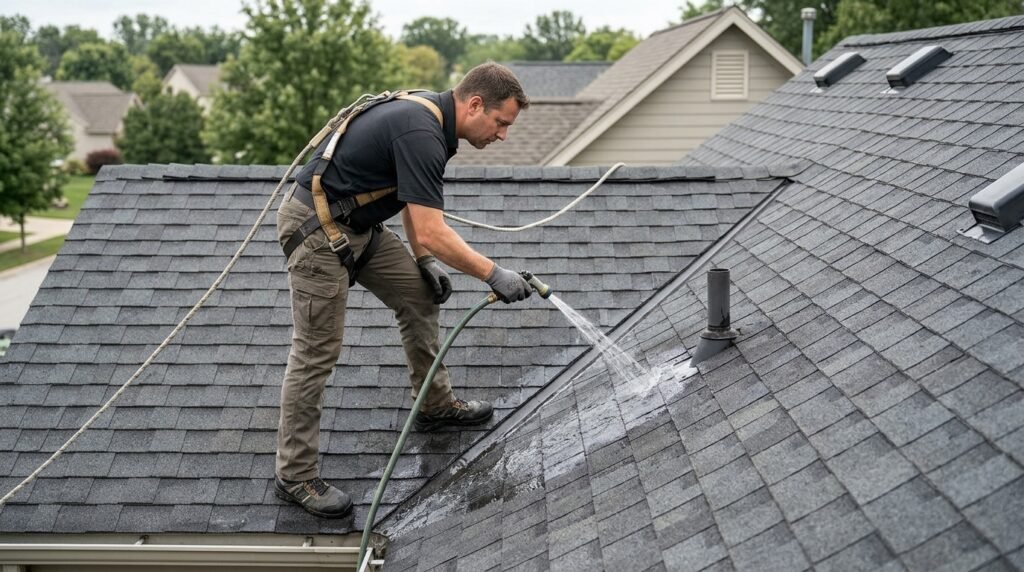
Check the drains. Look at each outlet. Is it blocked with debris? Does it drain when you pour water in?
Do a simple water test. On a dry day, pour a bucket of water slowly near a suspected low spot and watch where it goes. Does it run to the drain, or sit?
Look for the tide-marks. Rings of dirt or algae show where water has been sitting, even on a dry day.
Check inside. Look at the ceilings below, especially under any pooling area, for stains, damp patches and peeling paint.
Write down what you find. A clear set of photos with dates makes it much easier for a roofer to work out the cause. Our guide on how to check your roof for damage from the ground has more tips on photos and safe checking.
Quick fixes you can do yourself
Some causes are simple, and you can deal with them safely.
- Clear the drains and outlets. Remove leaves, dust, plastic, rubbish and mud, by hand with gloves, and flush with water to check it flows. Don’t poke around with sharp tools that could damage the waterproofing around the outlet.
- Clear the pipes and downpipes. If water backs up, flush from the top or push a hose up from the bottom. A rod or a plumber’s snake can help with stubborn blockages.
- Remove debris and rubbish from the roof surface, and anything that blocks the flow of water.
- Move or raise loose items. Boxes, planters and old materials sitting on the roof can dam the water.
- Sweep standing water toward the drain with a soft broom, after rain, if it’s safe. It helps in the short term, but it isn’t a fix.
- Fit a basic drain guard or mesh over outlets to catch leaves, if it fits properly and doesn’t block the flow. Check and clean it regularly.
These won’t solve a slope or sagging problem, but they stop a blocked drain from making things worse. If clearing the drains doesn’t solve it, you’re looking at something structural or built-in, and it’s time to call someone.
Proper fixes for each cause
| Cause | Typical fix |
|---|---|
| Blocked drain or pipe | Clear it, flush it and check it regularly |
| Not enough outlets | Add outlets or spouts in the right places |
| Outlet set too high | Lower or reform the outlet and the surrounding surface |
| Outlet or pipe too small | Increase the size or add more |
| Low spots and dips | Fill and level with a sloped (tapered) screed or repair layer, then re-waterproof |
| Not enough overall slope | Lay a new sloped screed, or tapered layers, to give a proper fall, then waterproof |
| Obstructions like tank stands and steps | Move, raise or redesign them so water can flow past |
| Worn or damaged waterproofing | Repair or renew the waterproofing, after fixing the slope |
| Cracks in the surface | Repair the cracks, then waterproof the area |
| Sagging or deflection | Have a structural assessment, then repair or strengthen as advised |
| Blocked valley on a pitched roof | Clear it, and check the flashing and metal |
| Sag in a pitched roof | Check for wet or rotten wood, and repair the structure and roofing |
The important point: fixing the waterproofing without fixing the slope usually doesn’t work. If the water can’t run off, even brand new waterproofing will wear out early.
How roofers correct slope problems
Slope problems are the ones that need a professional, because the work has to be done in the right order.
- Inspect and measure. The roofer finds where water sits, checks the levels, the drains and the existing layers and finds the cause.
- Prepare the surface. Old coatings, loose layers and damaged material are removed where needed, and cracks are repaired.
- Reform the slope. A new screed or tapered layers are laid to give a steady fall toward the outlets, usually with the lowest point at the drain. The aim is to remove the low spots and let the water run off.
- Adjust the outlets. Drains and spouts are reset to the right level, so they sit at the lowest point and not above it. More outlets are added if the roof needs them.
- Waterproof. A suitable waterproofing system is applied over the corrected surface, carried up the walls and around outlets and penetrations.
- Test. Once it’s done, the roof is checked, ideally by wetting it or after the next rain, to confirm that the water runs off properly.
This kind of job needs dry weather and time to cure, so it’s best planned before the rainy season. Don’t let anyone patch over a slope problem with a thin coating and call it fixed.
Waterproofing and pooling
Waterproofing and drainage work together, and both matter.
- Waterproofing keeps water out, but only if it stays intact. Standing water is hard on it.
- A good slope keeps water moving, so the waterproofing has less work to do.
- If the waterproofing is old, peeling, bubbling or cracked, and the roof also pools water, fix the slope first, then renew the waterproofing. Doing it the other way round wastes money.
- Check around outlets, parapets, pipes and tank bases, where waterproofing is most likely to fail and where water tends to collect.
- Do the work in dry weather, because most waterproofing needs dry conditions to bond and cure properly.
If you want to know how long a waterproofing layer should last and when to renew it, our guide on how long a roof lasts gives rough ranges.
When pooling points to something serious
Most pooling is a drainage or slope problem, but a few signs mean you should get help quickly.
- the pool is getting bigger or deeper over time
- there’s a visible sag or dip in the roof or the ceiling below
- ceilings are stained, bulging or sagging under the pooled area
- you see new cracks in the ceiling, walls or the slab
- doors or windows are suddenly sticking
- you can see rust-coloured stains, which can point to corroded reinforcement
- water is leaking inside after rain
- the pooled water is very heavy, like a large area many centimetres deep
These can point to structural movement or long-term water damage. Don’t go onto the roof to look more closely, and keep people away from any ceiling that looks unsafe. Our guide on signs of emergency roof damage can help you judge how urgent it is.
How to prevent it
Most pooling can be prevented, or caught early.
- Keep drains, outlets and spouts clear all year. Clean them before the rains and after big storms.
- Check the roof after heavy rain, and note where water sits.
- Don’t build up layers without thinking. Before adding another coating or layer, make sure the slope and outlet levels still work.
- Keep the roof free of rubbish and loose items that can block the flow.
- Place tanks, dishes and equipment so they don’t block drainage paths, and raise them clear of the surface where possible.
- Fix cracks and waterproofing damage early.
- When building or renovating a flat roof, insist on a proper fall toward adequate outlets, and ask how the levels will be checked.
- Follow a regular maintenance routine. Our guide on how to maintain your roof throughout the year gives a season-by-season plan.
If you want to read more about roof drainage and good practice, the National Roofing Contractors Association (NRCA) and the Asphalt Roofing Manufacturers Association (ARMA) publish guidance on roofs and drainage, and InterNACHI explains common drainage and moisture problems in plain language.
What affects the cost
There’s no single honest figure, because it depends on the cause. A blocked drain costs very little, while reforming the slope of a whole roof and renewing the waterproofing is a much bigger job.
The main things that affect the price are:
- The cause. Clearing a drain, adding an outlet, fixing a few low spots and re-sloping a whole roof are very different amounts of work.
- The size of the roof and how much of it is affected.
- The existing layers. Old, thick layers may need to be removed.
- The waterproofing system you choose.
- Access, and the extras like scaffolding and waste removal.
- Hidden damage, like cracked concrete, corroded reinforcement or damaged ceilings below.
The only reliable figure is a written quote after an inspection. Our guide on how much roof repair costs explains what to look for in a quote.
When to call a professional
Some jobs are fine to do yourself, like clearing drains safely. Others need someone who works on roofs every day. Call a professional if:
- clearing the drains doesn’t solve it
- water keeps pooling in the same places
- the pool is large, deep or growing
- you can see a dip, a sag or new cracks
- the waterproofing is peeling, bubbling or cracked
- you have stains, drips or damp under the pooled area
- you can’t reach the roof safely
- you’re planning a new waterproofing layer and want to be sure the slope is right
A proper inspection finds out why the water is pooling, not just where, and tells you what to fix first.
FAQ
Why does water pool on my roof after rain?
Because it can’t drain away. The usual causes are blocked drains, not enough slope, low spots or dips, outlets set too high, too few outlets, things blocking the water’s path and, sometimes, sagging. On pitched roofs, it’s usually a blocked valley or gutter, or a dip in the roofline.
How long should water stay on a roof after rain?
A thin film should be gone within hours on a warm day. As a common rule of thumb, water still sitting after about 48 hours in dry, warm weather counts as ponding and needs attention.
Is pooling water on a roof bad?
Yes, if it stays. It makes leaks more likely, wears out waterproofing faster, adds weight, grows algae and breeds mosquitoes. It can also make a slight sag worse over time.
Can pooling water cause a roof leak?
Yes. Standing water finds cracks, worn joints and weak waterproofing, and leaks follow. It’s one of the most common causes of flat roof leaks.
How do I stop water pooling on a flat roof?
Start by clearing the drains and outlets. If water still sits, you may need to correct the slope, adjust or add outlets, fill low spots and renew the waterproofing. A roofer can tell you which.
Can I fix pooling water myself?
You can clear drains and remove debris safely. Fixing the slope, adding outlets or waterproofing needs a professional, and mistakes can make things worse. Don’t go onto a wet or fragile roof.
Is a flat roof supposed to have a slope?
Yes. A flat roof should have a gentle fall toward the drains, so water runs off. If it doesn’t, water will sit.
Why does water pool on my roof even though the drain is clear?
Because the drain isn’t the problem. The roof may not slope enough, there may be low spots, the outlet may be set too high, there may be too few outlets, or something may block the water’s path.
Does pooling water mean my roof is sagging?
Sometimes. If the pool is big, growing or paired with a visible dip, stained ceilings or new cracks, it can point to sagging or structural movement. Get it checked soon.
Should I be worried about mosquitoes?
Yes. Standing water is a place where mosquitoes breed. Clearing it and fixing the drainage helps protect your family, especially in the rainy season.
Final thoughts
Water pooling on a roof isn’t something to put up with. It’s the roof telling you that the drainage isn’t working, and the longer you leave it, the more damage the water does and the bigger the fix becomes.
Start with the simple things: clear the drains, remove anything in the way and look at where the water sits and for how long. If that doesn’t solve it, the cause is probably the slope, the outlets or the waterproofing, and it’s worth having a professional look before you pay for anything.
If water keeps pooling on your roof, book a roof inspection with AurexCity. We’ll find out why, show you what we find and explain what needs doing. Contact us here.