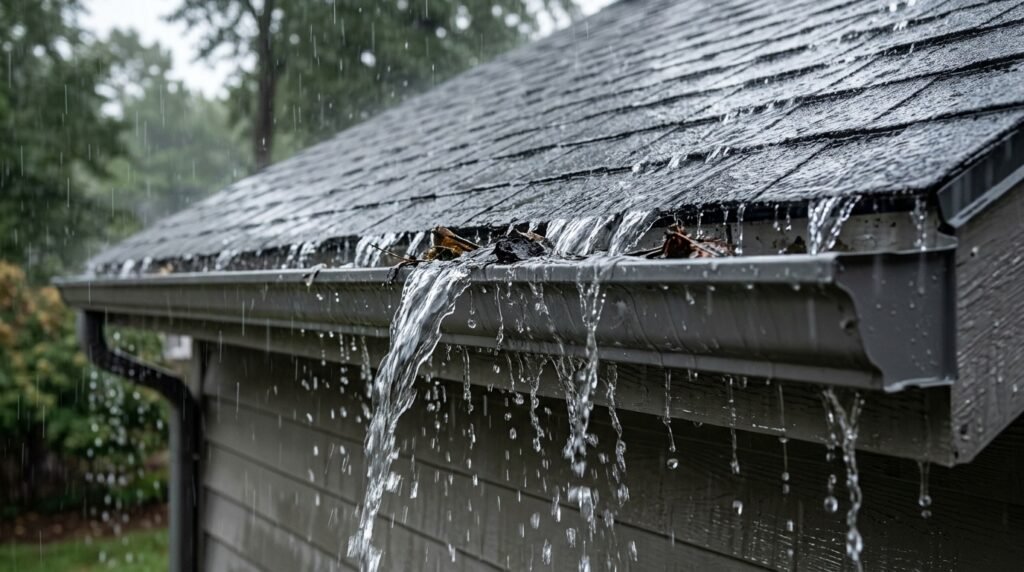
To keep gutters from damaging your roof, keep them clean, keep them sloping gently toward the downpipes, keep them firmly fixed, and make sure the water they collect is carried well away from the house. That’s really the whole job. Gutters are meant to protect your roof and walls, but a blocked, sagging or leaking gutter does the opposite. It sends water to exactly the places you don’t want it: under the roof covering, behind the fascia, into the walls and down into the foundations.
The good news is that gutter problems are some of the cheapest and easiest roof problems to prevent. Below, we’ll show you how gutters cause damage, how to spot the warning signs, and the simple routine that stops it. If you’ve already got a stain on the ceiling and you’re not sure why, our guide on why a ceiling leaks after heavy rain will help you with the first steps.
Want someone to check your gutters and roof edge? Contact AurexCity to book an inspection, meet the team on our About Us page, or browse more roofing guides. If you’d like to know what a proper inspection involves, read how professionals find hidden roof leaks.
Table of Contents
- How gutters end up damaging roofs
- Common gutter problems and what they do
- Signs your gutters are hurting your roof
- Clean your gutters regularly
- Check the slope and the fixings
- Fix leaks, joints and rust
- Downpipes and where the water goes
- Trees and debris
- Do gutter guards help
- Check the fascia, soffit and roof edge
- What about flat concrete roofs
- A simple gutter maintenance schedule
- Staying safe while you work
- When to call a professional
- FAQ
- Final thoughts
How gutters end up damaging roofs
A gutter’s job is simple: catch the water running off the roof and carry it to a downpipe, which takes it to the ground, away from the house. When that works, water never gets a chance to hang around your roof edge.
When it doesn’t work, a few things happen.
- Water spills over the edge, runs down the wall and soaks the fascia boards and the wood behind them.
- Water backs up under the roof covering. If a gutter is full, water can be forced back up under the first row of tiles or shingles and into the wood underneath.
- The wood rots. Fascia boards, rafter ends and the wood along the roof edge stay damp, and damp wood decays. Rot you can’t see can spread inwards.
- Weight builds up. A gutter full of wet leaves, mud and standing water is heavy. It can pull away from the wall and tear fixings out of the fascia.
- Water ends up at the foundations. If downpipes dump water right next to the house, it can soak into the ground, cause damp in the walls and, over time, affect the structure.
- Ice causes damage in cold, snowy areas. Water that can’t drain can freeze at the roof edge, and the ice can lift tiles and push water under the roofing.
So the roof itself can be in perfect shape, and a neglected gutter can still cause leaks, rot and expensive repairs.
Common gutter problems and what they do
| Problem | What it causes | How to spot it |
|---|---|---|
| Blocked with leaves and debris | Overflow, back-up under the roof edge, rot | Water spilling over in rain, plants growing in the gutter |
| Sagging or pulling away | Water spills behind the gutter, onto the fascia and the wall | Gutter dips in the middle, gap between the gutter and the wall |
| Wrong slope | Standing water, overflow | Water sits in the gutter after rain, or runs to the wrong end |
| Leaking joints | Drips onto the wall and the ground, staining and damp | Streaks below the joints, drips even in light rain |
| Rust and holes | Leaks, and weaker gutters | Orange-brown patches, flaking metal, holes |
| Blocked or cracked downpipes | Overflow, water running down the wall | Water coming out of the top of the pipe, damp patches below |
| Downpipes dumping next to the wall | Damp walls, foundation problems | Wet ground and stains near the base of the wall |
| Gutters too small for the roof | Overflow in heavy rain | Water jumping the gutter in a downpour, even when it’s clean |
| Missing drip edge or gap behind the gutter | Water running behind the gutter onto the fascia | Stains and rot along the fascia |
Most of these are simple to fix, as long as you catch them early.
Signs your gutters are hurting your roof
You can spot a lot from the ground, especially during or just after rain. Look for:
- Water spilling over the edge of the gutter, rather than flowing along it
- Streaks and stains on the outside wall below the gutter
- Peeling paint, soft or stained fascia boards, or wood that looks dark or crumbly
- Sagging, bowed or loose gutters, or gutters that have pulled away from the wall
- Standing water or mud in the gutter a day after rain
- Plants, moss or small trees growing in the gutter
- Granules from shingles collecting in the gutter, which means the roof surface is wearing out. Our guide on why roof shingles bow or bulge explains how problems under the surface can show up on top.
- Water pooling against the base of the wall
- Damp patches or stains on ceilings near the outside walls, which can mean water is getting in at the roof edge
- Wet or rotten wood under the roof edge, if you can see the underside
One or two of these is a good reason to look closer. Several together mean the gutter needs attention soon.
Clean your gutters regularly
This is the single most useful thing you can do. A clean gutter lets water flow, so nothing backs up.
How often? It depends on where you live and what’s around the house. As a rough guide, clean them at least twice a year: once before the rainy season and once before winter. If you have trees overhanging the roof, or you live somewhere dusty, you may need to clean more often. Also check after a big storm.
How to do it:
- Scoop out leaves, mud and debris by hand (wear gloves), or with a small trowel or gutter scoop. Put it in a bucket, not on the ground below, where it will wash back into the downpipe.
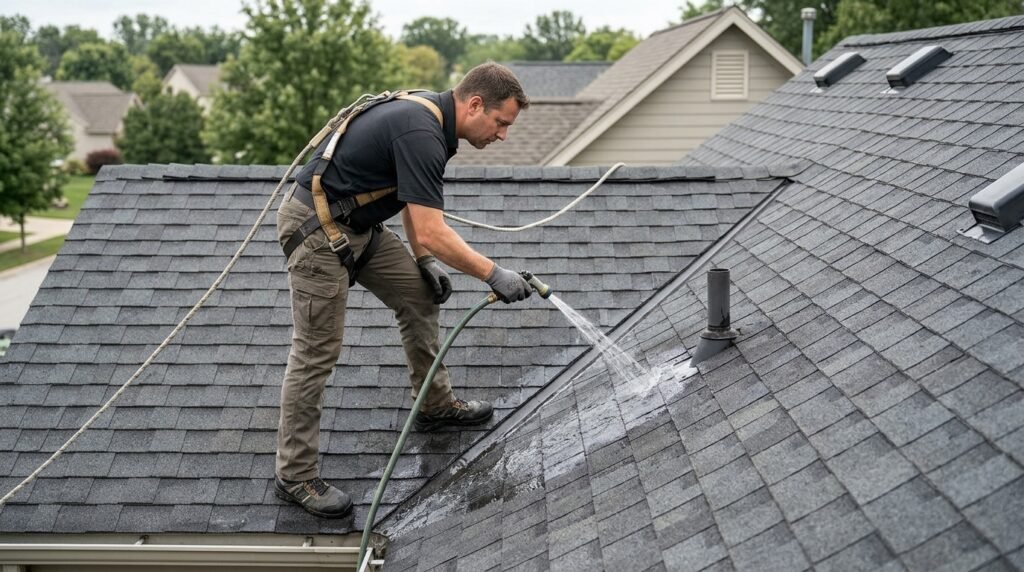
- Flush the gutter with water from a hose, working toward the downpipe. Watch where the water goes. It should flow smoothly and run out of the bottom of the downpipe.
- Clear the downpipe if water backs up. Flush it from the top, or push a hose up from the bottom. Stubborn blockages may need a rod or a plumber’s snake.
- Check for leaks while the water runs. Look at the joints and the corners for drips.
- Look at what you found. Lots of granules means the roof surface is ageing. Twigs and nests mean a tree needs trimming.
This is also the best time to check the gutter’s condition, since you’re up close.
Check the slope and the fixings
A gutter has to slope gently toward the downpipe, so water runs along it and doesn’t sit. A common guideline is about a quarter of an inch of fall for every ten feet of gutter, which is only a slight tilt. Too flat, and water pools. Too steep, and it can overshoot the downpipe or look wrong.
To check:
- Pour water in and watch. After heavy rain, see where water sits. Standing water means a low spot.
- Look along the gutter from the ground or the ladder. It shouldn’t dip in the middle or tilt away from the downpipe.
- Check the brackets and hangers. They should be firmly fixed to solid wood, and spaced closely enough to hold the gutter up when it’s full. A common spacing is every two to three feet, but it depends on the gutter and the roof.
- Look at the fascia where the screws go in. If the wood is soft or rotten, the screws won’t hold, and the gutter will keep sagging.
- Look for gaps between the gutter and the fascia, where water can run behind.
If a gutter sags, don’t just push it back up. Find out why. It might be loose fixings, rotten wood, or the weight of debris. Re-fix it, and replace any damaged brackets or rotten fascia.
Fix leaks, joints and rust
A small leak is easy to ignore. But a constant drip soaks the wall and the fascia, and it can be worse than a big blockage.
- Joints and corners are the most common leak spots. Clean them, and reseal with a sealant suitable for gutters. If they keep leaking, the joint may need to be re-made or replaced.
- Small holes and rust spots in metal gutters can be patched if they’re minor. Clean the area, treat the rust and apply a proper repair patch or sealant.
- Badly rusted or cracked gutters usually need replacing. Patching a gutter that’s falling apart is a short-term fix.
- Cracks in plastic gutters can sometimes be repaired, but if they’re brittle and sun-damaged, replacement is better.
Don’t smear a thick layer of roof cement over everything. It hides the problem and doesn’t last.
Downpipes and where the water goes
A gutter is only as good as what’s at the end of it.
- Make sure downpipes aren’t blocked, cracked or loose.
- Check the bottom. Water should come out and run away from the house, not pool beside the wall. A common guideline is to carry it at least a metre or two away, using an extension, a drain or a splash block.
- Check the ground slopes away from the walls, so the water doesn’t flow back toward the house.
- Watch out for downpipes that empty onto a lower roof. The water can flood the roof below and wear it out. They should connect to another gutter or run to the ground.
- Make sure underground drains aren’t blocked, if your downpipes connect to them.
- Consider a water butt or tank. It collects the rain for the garden, but make sure it has an overflow that carries water away.
If water is pooling against the house, damp walls and foundation problems are a real risk, so it’s worth fixing early.
Trees and debris
Trees are the main reason gutters block, and they also scrape and damage the roof.
- Trim branches that hang over the roof, so leaves, twigs and seeds don’t fall into the gutter. Keep branches clear of the roof surface, because in wind they scratch tiles and shingles.
- Be careful with big branches. If tree work is near the house or power lines, leave it to someone with the right equipment.
- Clear plants early. Seeds that land in the gutter will sprout in the mud and clog it.
- Think about dust and bird droppings, which also build up and hold moisture. Regular cleaning handles them.
- Check for nests. Birds and insects love gutters and downpipes, and they can block the flow.
If you’re in a dusty area, expect more cleaning in the dry season, and check again before the rains.
Do gutter guards help
Gutter guards, covers and mesh are meant to keep leaves out. They can help, but they aren’t a magic fix.
Possible benefits:
- fewer leaves and larger debris in the gutter
- less frequent cleaning
- some help if you have a lot of trees
Things to watch out for:
- fine dust, seeds and small debris can still get through, and sometimes build up on top
- some designs clog on top and make water jump over the edge
- they can make it harder to see problems in the gutter
- poorly fitted ones can trap water or lift the bottom row of roofing
- you still need to check and clean them from time to time
If you’re thinking about guards, ask a roofer which type suits your roof, your trees and your climate. A bad choice can create more problems than it solves. And you still need to check the gutter underneath once or twice a year.
Check the fascia, soffit and roof edge
When gutters fail, the first victims are the parts right behind them.
- Fascia boards (the boards along the roof edge) should be firm, straight and well painted. Soft, flaking, dark or stained boards mean water has been getting at them.
- Soffits (the underside of the overhang) should be dry and intact. Stains, peeling paint or sagging can mean leaks from above, or poor ventilation.
- The first row of roofing should sit flat and be well fixed at the edge. If tiles or shingles at the edge are lifted, cracked or stained, water may be getting under them.
- Drip edge or edge flashing, where there is one, should direct water into the gutter, not behind it.
If you find soft or rotten wood, replace it. Fixing the gutter alone won’t stop the damage from carrying on. If you want to read more about the roof edge and ventilation, our guide on roof ventilation explains how air moves under the eaves.
What about flat concrete roofs
Many homes have flat concrete roofs, and they handle water differently. Instead of gutters, they usually have drain outlets, spouts or pipes through the parapet wall that carry water away.
The same ideas apply:
- Keep the outlets clear of leaves, dust and rubbish. A blocked outlet means water pools on the roof.
- Check the slope. Water should run toward the outlets, and not sit in low spots.
- Check where the water lands. Spouts and pipes shouldn’t dump water against the wall below.
- Look at the waterproofing near outlets, since cracks and gaps there let water in.
- Check the parapet and edges for cracks and stains.
Standing water on a flat roof is a leak waiting to happen, so clearing outlets before the rainy season is one of the best things you can do.
A simple gutter maintenance schedule
| When | What to do |
|---|---|
| Before the rainy season | Clean gutters and downpipes, flush them, check slope and fixings, fix leaks, check outlets on flat roofs |
| During heavy rain | Watch from the ground for overflow, spills or sagging |
| After a big storm | Check for debris, damage and loose gutters |
| Before winter | Clean again, check for rust and holes, trim branches |
| After leaf or dust season | Clean again, especially if trees overhang the roof |
| Once a year | Check the fascia, soffit and roof edge, and look at the downpipes and drainage |
| Whenever you see a problem | Fix it early, before it spreads |
Write the dates in your phone. A reminder twice a year is all it takes.
Staying safe while you work
Gutter cleaning is one of the most common ways people get hurt at home, so please take it seriously.
- Use a stable ladder on firm, level ground, and have someone hold it. Never lean out to the side. Move the ladder instead.
- Never climb onto the roof to reach a gutter.
- Stay away from power lines. Look up before you set up a ladder.
- Wear gloves and eye protection. Gutters can contain sharp metal, glass and nasty things.
- Avoid wet, windy or icy conditions.
- Don’t overreach. If you can’t do it from the ladder safely, don’t do it.
- If you’re not comfortable on a ladder, or the house is tall or awkward, hire someone. It’s not worth a fall.
A cleaning tool with a long handle, or a hose attachment made for gutters, can help you work from the ground in some cases.
When to call a professional
Some jobs are fine to do yourself. Others need someone who works on roofs and gutters every day. Call a professional if:
- the house is tall, steep or awkward to reach
- gutters are badly rusted, cracked or sagging
- fascia boards or rafter ends are soft or rotten
- you can see damp, stains or rot under the roof edge or on the ceilings inside
- water keeps overflowing even though the gutter is clean, which can mean it’s too small or the slope is wrong
- downpipes are blocked and you can’t clear them
- you’re not sure what you’re looking at
A proper inspection looks at the gutters, the roof edge and the roof together, so you find out whether the gutter is just a gutter problem or part of something bigger. If you want to read more about good practice, the National Roofing Contractors Association (NRCA) and the Asphalt Roofing Manufacturers Association (ARMA) publish guidance on roof drainage and maintenance, and InterNACHI explains common gutter and drainage problems in plain language.
FAQ
How do gutters cause roof damage?
When they’re blocked, sagging, leaking or badly sloped, water overflows, backs up under the roofing, soaks the fascia and rafter ends, and runs down the walls. Over time, that causes rot, leaks, stains and damp. Heavy, debris-filled gutters can also pull away from the wall.
How often should I clean my gutters?
At least twice a year, before the rainy season and before winter. More often if you have overhanging trees or live in a dusty area, and after any big storm.
What’s the best way to stop gutters overflowing?
Keep them clean, make sure they slope toward the downpipes, check the downpipes aren’t blocked and make sure the gutters are big enough for the roof. If a clean gutter still overflows in heavy rain, it may be too small or incorrectly sloped.
Why is my gutter overflowing when it’s clean?
Usually because the downpipe is blocked, the slope is wrong, there aren’t enough downpipes, or the gutter is too small for the amount of roof draining into it. A professional can check.
Can a blocked gutter cause a roof leak?
Yes. When water can’t drain, it can back up under the first row of tiles or shingles and soak the wood underneath. That can lead to leaks and rot at the roof edge.
Are gutter guards worth it?
They can reduce larger debris and cleaning, but they don’t stop fine dust and seeds, and a bad fit can cause problems. You still need to check and clean them. Ask a roofer what suits your roof and trees.
Where should downpipes drain to?
Away from the house, ideally a metre or two or more, onto ground that slopes away, or into a proper drain. They shouldn’t empty against the wall or onto a lower roof.
What if I have a flat concrete roof?
The same ideas apply, with drain outlets and spouts instead of gutters. Keep the outlets clear, check the roof slopes toward them, and make sure the water doesn’t dump against the wall.
Is it safe to clean gutters myself?
It can be, if you use a stable ladder on firm ground, have someone to hold it, stay away from power lines and never climb onto the roof. If the house is tall or awkward, or you’re not comfortable, hire someone.
Final thoughts
Gutters are small, dull and easy to forget, which is exactly why they cause so much damage. A few hours twice a year, cleaning them out, checking they slope and hold firm, fixing leaks and making sure the water goes somewhere sensible, can save you from rotten fascia, damp walls and a leaking roof edge.
The cheapest roof repair is always the one you do before the problem starts. Check your gutters before the rains and before winter, and fix small things early. And if you find rot, damp or a gutter that won’t behave, get someone to look at the whole roof edge, not just the gutter.
If you’d like your gutters and roof checked, book a roof inspection with AurexCity. We’ll look at the gutters, the roof edge and the roof, show you what we find and explain what needs doing. Contact us here.