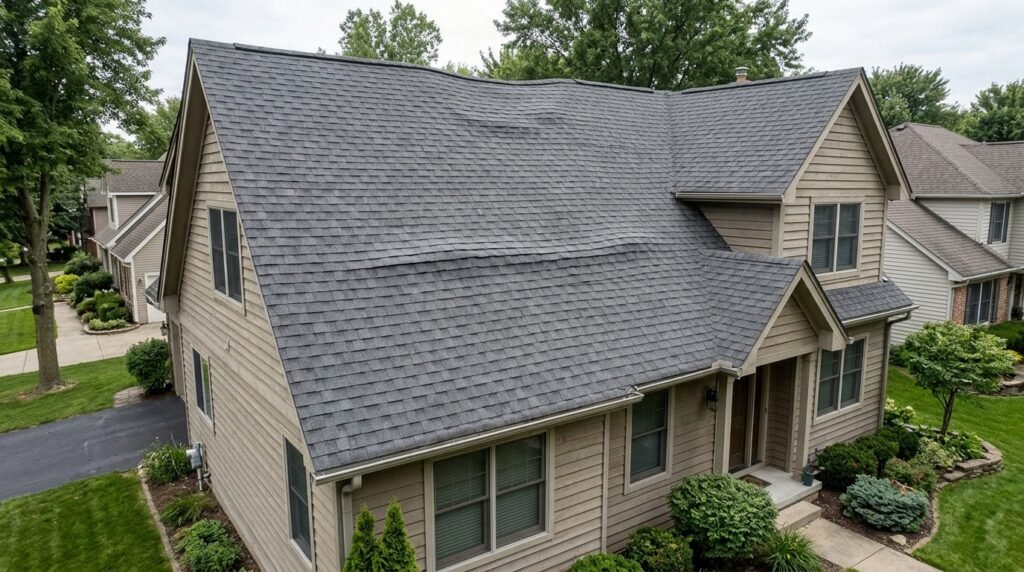
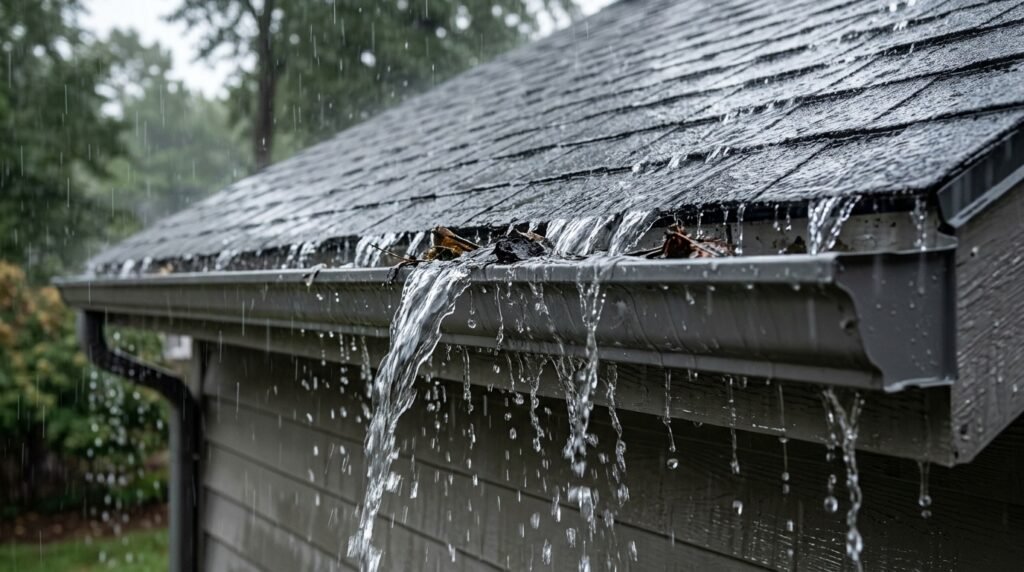
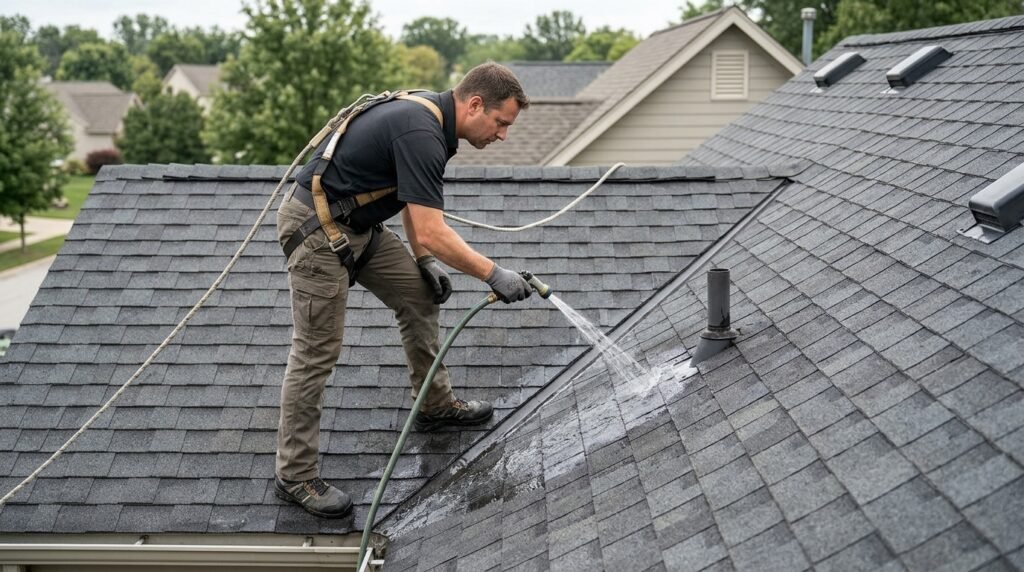
Yes, damaged roof flashing can cause a leak, and it’s one of the most common reasons roofs leak. Flashing is the thin strip of metal that seals the joints around chimneys, walls, vents and valleys. When it cracks, bends, rusts or comes loose, rainwater gets straight into your roof. Very often the rest of the roof is still in good shape, which is why flashing leaks catch people by surprise.
They’re also annoying to track down. They tend to show up only in heavy rain or strong wind, the stain on the ceiling is often far from where the water came in, and the damage is easy to miss from the ground. Below, we’ll show you how to spot damaged flashing, what causes it and how it’s properly repaired. If you’ve already got a stain, our guide on why a ceiling leaks after heavy rain will help you with the first steps.
Want someone to check your flashing? Contact AurexCity to book an inspection, meet the team on our About Us page, or browse more roofing guides. If you’d like to see how a hidden leak gets traced, read how professionals find hidden roof leaks.
Table of Contents
- What roof flashing actually does
- How water gets in when flashing fails
- Signs of damaged flashing inside the house
- Signs of damaged flashing outside
- What damages flashing in the first place
- The spots where flashing fails most often
- How to check your flashing safely
- How damaged flashing is repaired
- Repair or replace
- What affects the cost
- How to keep flashing in good shape
- FAQ
- Final thoughts
What roof flashing actually does
Think about every place on your roof that isn’t a simple, flat slope. Where the roof meets a chimney. Where two slopes join in a valley. Where a pipe pokes through, where a wall rises above the roof, where a skylight sits. Each of those is a joint, and joints are where water loves to sneak in.
Flashing is the thin material, usually galvanized steel, aluminium, copper or lead, that covers those joints. Its job is simple: catch water and steer it back onto the roof so it runs down toward the gutters. It doesn’t stop water by being tough. It stops water by being shaped and layered correctly, so gravity does the work.
That’s the important part. Flashing isn’t a seal, it’s a path. When it bends, lifts, rusts through or comes away, the path breaks, and the water follows a new one, straight into your roof structure. Most roofers will tell you the shingles or tiles get all the credit, while flashing does the hard, unglamorous work at the most vulnerable points.
How water gets in when flashing fails
It helps to understand how it happens, because it explains why leaks look so odd.
- A gap opens up. If the metal has lifted or pulled away from the chimney or wall, rain can run behind it, down the back of the flashing and onto the roof deck underneath.
- The sealant gives out. Many flashing details rely on a bead of sealant or mortar in places. Sealant dries and cracks over time, and once it does, water slips through the hairline gap.
- The metal itself fails. Rust eats steel. Older flashing can end up with small holes you’d never see without climbing up for a close look.
- Wind pushes water uphill. This one surprises people. In a storm, wind-driven rain can be forced upward under loose edges that would be fine in a calm shower. That’s one reason some leaks only show up in bad weather.
Once water gets under the roof covering, it doesn’t usually drip straight down. It soaks into the wood, runs along a rafter, and finally appears as a stain on a ceiling several feet away from the real problem. So when someone says the leak is in the bedroom but the chimney is on the other side of the house, the chimney flashing may still be the answer.
Signs of damaged flashing inside the house
These are the clues you can spot from indoors.
- Water stains on the ceiling or walls, especially near a chimney, an exterior wall or a roof penetration.
- Stains that grow after heavy rain and dry out in between. A stain that comes and goes is a classic flashing or small-leak pattern.
- Peeling paint or bubbling plaster near the top of a wall.
- A musty smell in the attic or in a room under the roof, even when nothing looks wet.
- Damp insulation or dark marks on the rafters and roof wood when you look in the attic with a torch.
Signs of damaged flashing outside
You don’t need a ladder for some of these. Binoculars from the ground show a surprising amount.
- Bent or lifted metal along the edges of a chimney, wall or vent.
- Visible gaps between the flashing and whatever it should sit against.
- Rust streaks or orange-brown patches on the metal.
- Sealant that’s cracked, dried out or missing along the joints.
- Flashing that has slipped out of place or sits at an odd angle.
- Loose or missing shingles or tiles right next to the flashing. The edges beside flashing take a beating, so problems often show up in pairs.
- Stains on the outside wall running down from the point where the roof meets it.
One honest warning: a stain on your ceiling doesn’t prove the flashing is to blame. Leaks can also come from broken shingles or tiles, blocked gutters, poor ventilation or condensation. Flashing is a very common cause, not the only one, which is why a proper look matters before anyone starts patching.
What damages flashing in the first place
Flashing rarely fails overnight. It wears out, gets knocked, or was fitted badly from the start. These are the usual reasons.
- Age and weather. Metal expands in the heat and shrinks in the cold. In a place with hot summers and heavy monsoon rain, that cycle repeats thousands of times. Fixings loosen, sealant cracks and the metal gets tired.
- Rust. Steel without proper galvanizing rusts, and rust eventually becomes holes. Mixing metals that react with each other speeds it up.
- Storms. Strong wind can lift, bend or tear flashing away. Branches and flying debris can dent or knock it out of place. After a serious storm, the flashing is worth a look even if the shingles seem fine.
- Poor installation. Flashing that was overlapped the wrong way, nailed through the exposed face or left without proper sealing at the ends can leak within a few years, sometimes within the first season. A neat-looking job isn’t always a correct one.
- Sloppy earlier repairs. A thick blob of roof cement smeared over a problem is usually a short-term patch that hides the real issue. It cracks, water gets underneath and the damage carries on quietly.
- Building movement. Houses settle, chimneys shift a little and roofs flex with the temperature. Flashing that fitted perfectly when new can end up pulled apart by ordinary movement.
- Neglect. Leaves and debris collecting in valleys and behind chimneys hold moisture against the metal and speed up rust.
If you want to dig into why flashing cracks, bends or separates, that’s a topic of its own, and it helps to know before you decide what to fix.
The spots where flashing fails most often
Not all flashing is equally likely to cause trouble. These are the places we’d check first.
- Chimneys. A chimney has several pieces of flashing working together, and masonry moves differently from the roof. It’s the number one trouble spot on most houses.
- Valleys. Where two slopes meet, water from both rushes down the same channel. A crack or rust hole here sends a lot of water into a small area fast.
- Where the roof meets a wall. The flashing here is meant to be layered piece by piece with the roofing. If it’s missing, lifted or badly lapped, water runs behind the wall covering.
- Vent pipes and other things poking through. The rubber or metal collars crack in the sun, and rubber ones tend to wear out long before the roof does.
- Skylights. A skylight depends on correct flashing on all four sides, so any small mistake leaks.
- Dormers and roof edges. Anything that sticks out of the roof adds joints, and every joint needs its own flashing.
How to check your flashing safely
Blunt truth: roofs are dangerous, and no leak is worth a fall. If your roof is steep, high, wet or slippery, don’t go up. A check from the ground is often enough to tell you whether you need a professional.
From the ground:
- Stand back and scan the roof around chimneys, walls and vents, ideally with binoculars.
- Look for shiny, bent or lifted metal, gaps, rust patches and cracked sealant.
- Check the outside walls below roof junctions for streaks or stains.
From the attic, if you can get in safely:
- Use a torch to look at the underside of the roof near chimneys and pipes.
- Look for dark stains, damp wood, water trails and wet insulation.
- Try it after heavy rain, when the evidence is fresher. Damp to the touch means the leak is active.
A few rules for any check: never go on a wet roof, don’t walk on tiles or brittle shingles because you can crack them and make new leaks, and if you’re unsure about anything, call someone who does this every day.
How damaged flashing is repaired
The right fix depends on how bad the damage is. This is what roofers usually do, from small jobs to big ones.
Small repairs
- Resealing. If the metal is sound but the sealant has cracked, the old material is cleaned out and fresh, compatible sealant goes in. It’s quick, but only works when the flashing itself is in good condition.
- Fixing loose flashing back down. If a piece has lifted but isn’t damaged, it can often be refixed and sealed.
- Straightening a slight bend. Lightly bent metal can sometimes be reshaped, but metal that’s been creased usually can’t go back to its original form reliably.
Medium repairs
- Replacing a section. When part of the flashing is rusted or cracked, the damaged piece comes out and a new one goes in, overlapped correctly with the roofing around it. The word that matters there is correctly. A new piece fitted in the wrong order will leak just like the old one.
- Replacing pipe collars. A small, cheap fix that solves a lot of leaks.
Big repairs
- Redoing the flashing around a chimney, valley or wall. If it’s badly rusted, has been patched again and again or was poorly fitted in the first place, the honest answer is often to strip it out and redo the whole detail. That can mean lifting the roofing around it, fitting new flashing in proper layers and replacing any wet or rotten wood underneath.
- Repairing hidden damage. This is the part people forget. If water has been getting in for months, the wood below may be soft or rotten, and there’s no point fitting perfect new flashing over a deck that can’t hold a nail.
What a good repair looks like, step by step
- The roofer finds the real source of the leak, rather than guessing.
- The damaged material comes out and they look at what’s underneath.
- Any damaged wood is repaired.
- New flashing goes in, made of the right material and overlapped correctly.
- Sealant is used where it’s appropriate, but it isn’t the main protection.
- The work is checked, ideally after rain.
A word on doing it yourself. Small jobs, like resealing a slightly cracked joint or swapping a worn vent collar on a low, easy roof, are things some handy homeowners manage. But flashing is detail work, and mistakes don’t show. A repair that looks fine but was done in the wrong order can leak quietly for a year. If there’s any doubt, or it’s a chimney, valley, skylight or steep roof, bring in a professional. And please skip the tempting shortcut of covering everything in roof cement. It looks like a fix and usually turns into a bigger problem.
Repair or replace
Here’s a rough way to think about it.
Repair usually makes sense when:
- the damage is limited to one small area
- the metal is otherwise solid
- the roof itself is fairly young
- the problem is mainly sealant, a lifted edge or a worn pipe collar
Replacement usually makes sense when:
- rust is widespread
- the same spot keeps leaking after patches
- the flashing was fitted incorrectly
- there’s damage in several places
- the roof is near the end of its life anyway
If the roof surface itself looks like it’s swelling or dipping, that’s a different problem and worth reading about. Our guide on why roof shingles bow or bulge explains what that can mean.
What affects the cost
There’s no single honest figure, because it depends on the job. These are the main things that move the price:
- How big the affected area is. One vent collar costs far less than a full chimney redo.
- The material. Copper costs more than galvanized steel or aluminium.
- Access. A steep, tall or awkward roof takes more time and safety gear.
- Hidden damage. Rotten wood adds to the job.
- The roof type. Tile, metal and shingle roofs each have their own requirements.
- Whether the roof covering has to be lifted to reach the flashing.
The best advice we can give is to get a written quote after a proper inspection, and make sure it explains what will actually be done.
How to keep flashing in good shape
You can’t make flashing last forever, but you can give it a fair chance.
- Check your roof regularly, and after major storms.
- Keep valleys, gutters and roof edges clear of leaves and debris.
- Trim branches that hang over the roof.
- Fix small problems early. A cracked bit of sealant costs little. Rotten wood costs a lot.
- Use a qualified roofer for any flashing work, and ask how they’ll handle the overlaps.
- Don’t ignore small stains. A faint ceiling mark is often the first warning.
If you want to read more about good practice, the National Roofing Contractors Association (NRCA) and the Asphalt Roofing Manufacturers Association (ARMA) publish guidance on flashing and roofing details, and InterNACHI explains common flashing defects in plain language.
FAQ
Can damaged flashing cause a leak even if the shingles look fine?
Yes. Flashing protects the joints and edges, which are separate from the main roof surface. You can have a perfectly good roof covering with failed flashing at a chimney or wall, and it will still leak.
Why does my roof only leak during heavy rain?
Because heavy or wind-driven rain pushes more water, with more force, into small gaps. A slightly lifted edge of flashing might cope with a light shower and fail in a storm.
How long does roof flashing usually last?
It depends on the material, the climate and how well it was installed. Some lasts as long as the roof, while poor quality or badly fitted flashing can fail much sooner. Regular checks tell you more than any fixed number.
Can I fix roof flashing myself?
Minor jobs on a safe, low roof, like replacing a worn vent collar, are sometimes manageable. Flashing around a chimney, valley, skylight or wall is more technical, and mistakes can cause hidden leaks. When in doubt, hire a professional.
Is sealant enough to fix flashing?
Usually not as a long-term fix. Sealant can help as a second layer, but flashing is meant to work through its shape and overlaps. If it relies on sealant alone, the underlying problem is still there.
How do I know if the leak is from flashing or something else?
Look at where the stain is, when it appears and what’s on the roof above it. Leaks near chimneys, walls, vents or skylights point toward flashing, but other causes are possible. A roof leak inspection is the reliable way to be sure.
Should I call someone straight away?
If water is coming in, yes. Protect your belongings, put a bucket under the drip and arrange an inspection quickly. Delay tends to turn a small repair into a bigger one.
Final thoughts
So, can damaged roof flashing cause a leak? Absolutely, and it’s often the reason for leaks that seem to make no sense. The good news is that flashing problems can often be fixed without replacing the whole roof, especially when they’re caught early.
If you’ve noticed stains, rust, lifted metal or a leak that keeps coming back after rain, don’t wait for the next storm to find out how bad it is. Have it looked at properly, find the real source and deal with that, instead of patching the symptom.
If you’d like a hand, book a roof inspection with AurexCity. We’ll find out what’s causing the leak, show you what we find and explain your options plainly. Contact us here.