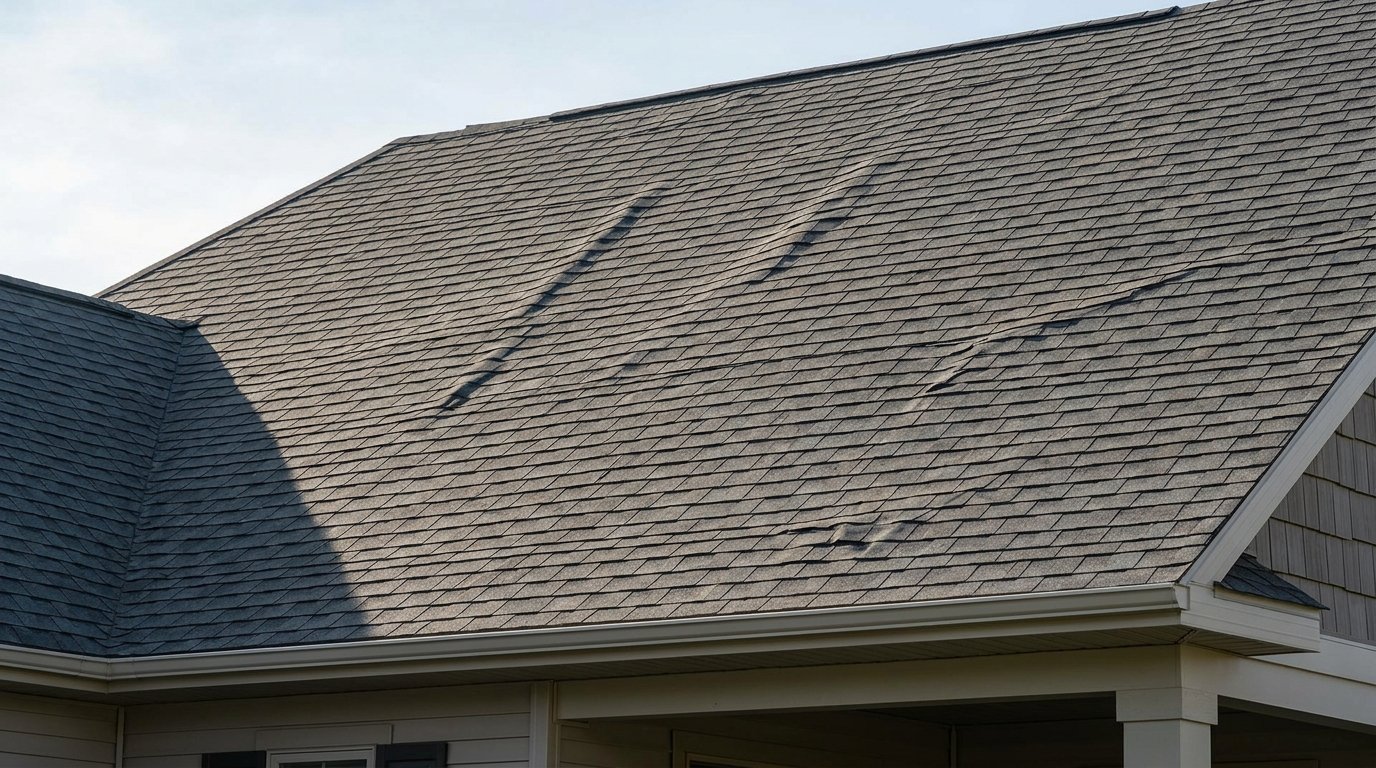
Why are new roof shingles buckling? On a new roof, buckling almost always comes from what’s under the shingles or how they were installed, not from the shingles themselves. The usual causes are damp or swollen roof decking, uneven decking joints, wrinkled underlayment, poor attic ventilation, incorrect nailing, and roofing over an uneven old surface. Defective shingles are possible, but they’re the rare explanation.
That’s good news in one way. If the cause is installation or the deck, it’s usually fixable, and you may have recourse with the installer.
If you want the general version of this topic, our guide to curling, cracking and buckling shingles covers shingles of any age. This article is for the roof that was only just put on, and the frustration of seeing it look wrong.
Buckling is when shingles rise up in ridges, waves or bumps instead of lying flat. You’ll often see it as a rippled pattern, sometimes in vertical lines running down the roof, sometimes in patches.
People often mix it up with other shingle problems, so here’s how to tell them apart:
| Problem | What it looks like | Common cause |
|---|---|---|
| Buckling | Raised ridges or waves across the shingle surface | Deck movement, moisture, wrinkled underlayment, poor installation |
| Curling | Edges turn up (curling) or the center lifts with edges down (cupping) | Age, heat, poor ventilation, moisture |
| Blistering | Small raised bubbles or pops, sometimes with granule loss | Trapped moisture or gas in the shingle, heat |
| Bowing / bulging | A visible bow or swelling across a section | Often the deck or structure underneath |
| Cracking | Splits across the shingle | Age, thermal stress, impact |
The terms overlap, and roofers use them loosely. What matters is what’s causing it, which is the next section.
It depends on how bad it is and what’s behind it.
Sometimes it’s mostly cosmetic. A few mild waves caused by underlayment wrinkles may look bad without letting in water straight away.
Sometimes it’s an early warning. Buckling raises shingle edges and breaks the seal between layers. Wind can then lift them, rain can get underneath, and fastener heads can poke through. Over time, buckled shingles crack, lose granules and wear out faster.
Sometimes it points to something bigger. If the cause is wet decking, serious ventilation problems or a damaged deck, the shingles are only the symptom. Left alone, that can lead to rot, mould and a much more expensive repair.
So the honest answer is that it’s rarely an emergency on day one, but it’s rarely something to ignore either. Get it assessed, especially while the roof is new and the installer is still reachable.
Here are the causes roofers find most often on brand-new or recently installed roofs.
This is one of the most common causes. If the plywood or OSB panels under the shingles were wet or damp when the roof went on, they can swell, dry out and shrink, or keep moving as they adjust. The shingles on top get pushed, pulled and rippled by that movement. It’s more likely if the deck was exposed to rain before roofing, or if the work was done in humid or wet weather. If you want to know how damp timber affects a roof, see our article on roof rot.
Roof deck panels need small gaps between them to allow for expansion. If they’re butted tightly together, or if the edges are uneven or sit at different heights, the panels can push against each other and ridge up. The shingles then follow the line of the ridge, often forming a straight line of buckling that matches the panel joints. That pattern is a strong clue.
Underlayment, the layer under the shingles, can wrinkle if it gets wet, isn’t laid flat or isn’t fastened properly. Those wrinkles can telegraph through the shingles above, especially in the sun. It’s common, and sometimes the buckling flattens a bit over time, but not always.
A hot, damp attic works against shingles from below. Trapped heat and moisture can make the deck and underlayment move, and can speed up shingle wear. If buckling is widespread, or you’ve noticed humidity, stuffiness or condensation in the attic, ventilation deserves a look. See our guide on roof ventilation.
Nails that are too high, too few, driven too hard or not hard enough, or placed at an angle can all cause shingles to shift and ripple. Over-driven nails can cut the shingle, and under-driven nails can poke up, pushing the shingle above them into a bump.
Putting new shingles over existing ones can save time, but the new layer copies every bump, curl and unevenness in the old one. If the old roof wasn’t flat or sound, the new shingles may look wavy or buckle soon after. Many roofers prefer a full tear-off for this reason.
Shingles stored wet, left stacked in heat or installed in extreme temperatures can behave badly. Installing in very hot weather or in damp conditions without care can contribute to ripples.
Shingles expand and shrink with temperature. If they were laid slightly crooked, or nailed in a way that doesn’t allow for normal movement, ripples can develop as the roof heats and cools. In a hot climate with strong sun, that cycle can be intense.
It does happen, but it’s far less common than the causes above. Most roofers and inspectors suspect installation or the deck first, and look at the shingles last.
| What you notice | Likely cause |
|---|---|
| Straight vertical or horizontal lines of buckling | Deck panel joints, swelling or no expansion gaps |
| Ripples that look like wrinkles under the surface | Wrinkled underlayment |
| Widespread buckling across the whole roof | Damp decking, ventilation or installation method |
| Buckling that appeared within weeks of installation | Wet deck, underlayment or deck movement |
| Bumps at nail locations | Raised or incorrectly driven nails |
| Wavy surface matching the old roof | Roofing over an uneven old layer |
| Buckling on the sunny side only | Heat and thermal movement |
| Damp or stuffy attic as well | Poor ventilation or trapped moisture |
It’s a guide, not a diagnosis. A close inspection, ideally including the attic, gives a proper answer.
If you’ve just paid for a roof and it’s buckling, here’s a sensible order of action.
1. Don’t walk on it or hammer it down. Walking on buckled shingles can crack them, and hammering them flat can break the seal or damage the deck below. It can also make a warranty claim harder.
2. Take clear photos. Wide shots of the whole roof and close-ups of the buckled areas, ideally from several angles and in different light. Low-angle photos in morning or evening light show buckling best. Date them.
3. Note the timeline. When was the roof installed? When did you first notice the buckling? What was the weather during installation? Did it rain before the roof was covered?
4. Gather your paperwork. The contract, invoice, warranty documents and any product information. These matter more than you’d think.
5. Check the attic. If you have safe access, look for damp timber, condensation, staining, mould or poor airflow. Take photos.
6. Contact the installer promptly. Be polite, specific and put it in writing, with photos. A good contractor will want to come back and look. Don’t wait months.
7. Consider an independent inspection. If you’re not comfortable with the installer’s explanation, or you can’t reach them, an independent roof inspector can identify the cause and document it. Our guide on when to get a roof inspection explains the situations where it’s worth it, and our article on how professionals find hidden leaks shows what a thorough inspection involves.
8. Don’t let another contractor start repairs before it’s documented. If a warranty claim is possible, changing the evidence can make it harder to prove.
This is the question most people really want answered. The honest answer is: it depends on the cause and your paperwork.
Workmanship warranty (from the installer). This usually covers errors in installation, like poor nailing, wrinkled underlayment, wet decking or missing expansion gaps. If the cause is installation, this is often the route to a fix.
Manufacturer’s warranty (from the shingle maker). This typically covers defects in the shingles themselves. Buckling caused by the deck, underlayment, ventilation or installation is often not treated as a manufacturing defect, so these claims can be difficult. Read the exact wording.
Home insurance. Usually doesn’t cover installation faults or gradual wear, but if damage was caused by a storm, it’s worth asking.
Practical tips:
I’m not a lawyer, and warranty terms vary, so check your own documents or take advice if there’s a dispute. Industry bodies like the Asphalt Roofing Manufacturers Association (ARMA) and the National Roofing Contractors Association (NRCA) publish technical guidance on asphalt shingle installation and common problems, which can help you understand what good practice looks like.
The right fix depends on the cause. A good roofer fixes the cause, not just the surface.
If buckling is minor, limited and doesn’t affect sealing, some roofers will recommend monitoring it. If it’s widespread, or tied to a deck or moisture problem, repair is usually the better option. Our guide on repair vs replacement can help you think about the larger decisions, and our breakdown of roof repair costs explains what affects pricing.
Most buckling isn’t an emergency, but take it seriously and act quickly if:
In those cases, the problem has gone beyond appearance. Our article on signs of emergency roof damage can help you judge it.
If you haven’t had the work done yet, or you’re about to hire someone, these questions help.
Industry resources like InterNACHI explain common roofing and ventilation problems in plain language, and are worth a read before you sign anything.
Usually because of the deck or the installation: damp or swollen decking, uneven panel joints, wrinkled underlayment, poor ventilation, incorrect nailing, or roofing over an uneven old layer. Defective shingles are possible but less common.
Slight waviness can happen, but obvious buckling isn’t something you should simply accept. It’s worth having it assessed, especially while your warranty is active.
Sometimes mild ripples caused by wrinkles settle a little, but often they don’t. If the cause is the deck or moisture, they usually won’t flatten on their own.
It depends. Installation-related causes are often covered by the installer’s workmanship warranty. Manufacturer warranties typically cover shingle defects, and they often exclude deck, ventilation and installation causes. Read your documents and report the problem promptly in writing.
Not always straight away, but buckling can break the seal, let wind lift shingles and allow water underneath. Over time, it increases the risk of leaks and early wear.
Please don’t hammer them flat or walk on them. You can crack shingles, damage the seal or void a warranty claim. Take photos, contact your installer and get a proper assessment first.
It can happen within days or weeks, particularly with wet decking or wrinkled underlayment. Some cases develop over the first season as the roof heats and cools.
Buckling is ridges or waves across the shingle surface. Curling is when the edges turn up or the shingle cups. They have overlapping causes, but buckling on a new roof usually points to deck or installation issues.
If the installer’s explanation doesn’t satisfy you, or you can’t get a response, yes. An independent inspection gives you a clear cause and documentation.
A new roof that’s buckling is frustrating, especially after paying for it. But it’s also usually explainable. Wet decking, deck joints, wrinkled underlayment, ventilation, nailing and old-roof surfaces account for most cases, and most of them can be fixed.
Don’t hammer it down, don’t ignore it and don’t wait months. Document it, contact your installer in writing and get an independent opinion if you need one. The sooner it’s looked at, the easier it is to find the cause and put it right.
If your new roof is buckling, or you’d like a second opinion on a roof you’re unsure about, book a roof inspection with AurexCity. We’ll look at the shingles, the deck and the ventilation, show you what we find and explain your options plainly. Contact us here.